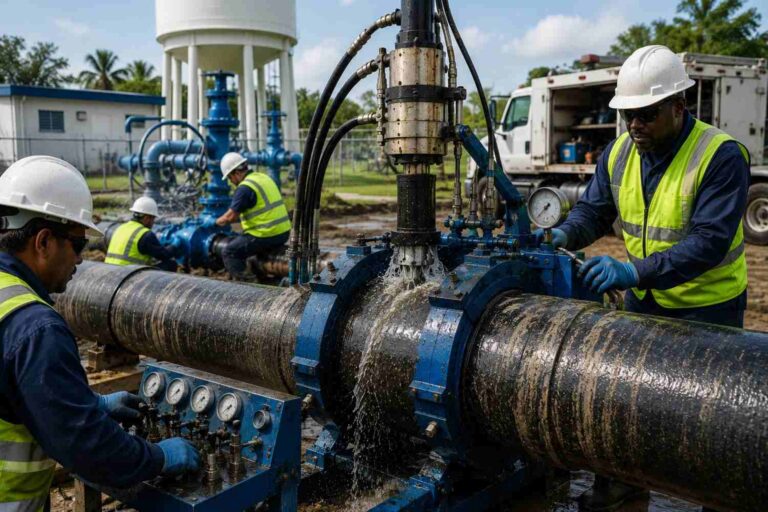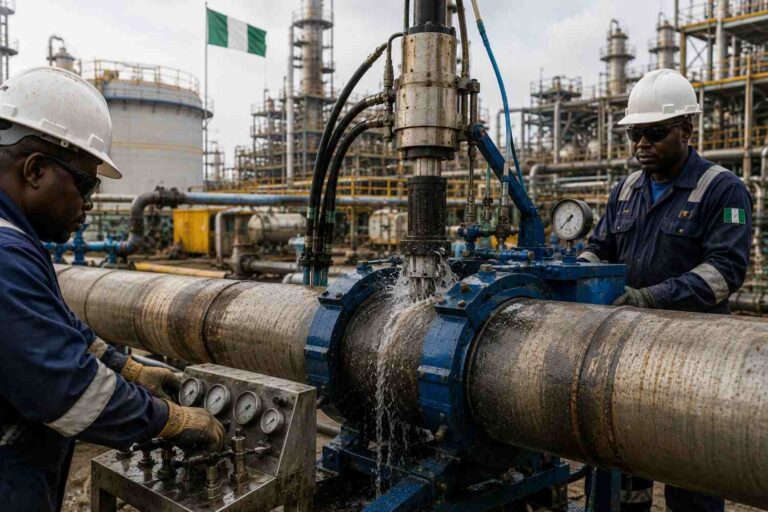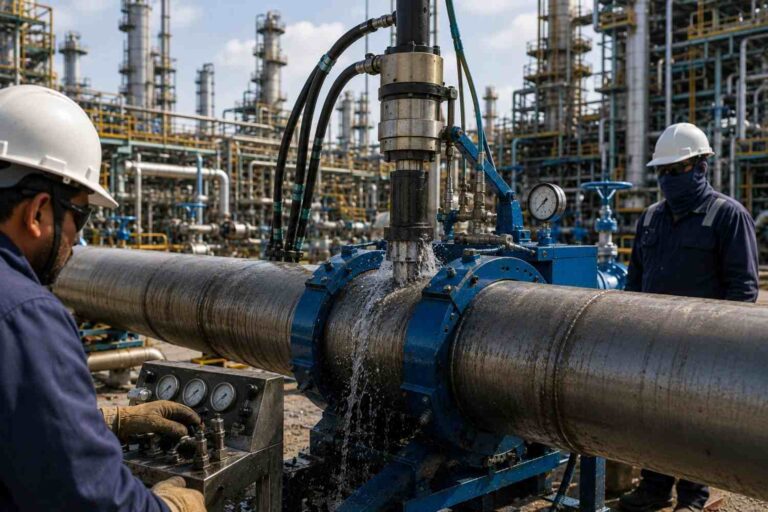

In the water distribution and chemical processing industries, pipeline maintenance is a constant operational reality. Valves wear out, fittings corrode, and system upgrades demand that sections of live pipework be isolated — often without the luxury of a planned shutdown. For decades, the conventional answer has been to drain the system, carry out the work, and refill. But in complex networks carrying treated water, aggressive chemicals, or temperature-sensitive fluids, that approach is costly, time-consuming, and environmentally risky.
This is where the pipe freezing procedure transforms the way engineers work. By creating a solid ice plug inside the pipe, a temporary and fully reversible isolation barrier is established — no valves, no draining, no system outages. At PTS (Pipeline Technical Services), cryogenic pipe freezing is one of our core specializations, deployed across water utilities, chemical plants, and industrial facilities throughout the globe.
This guide walks through the complete pipe freeze technique: from the science behind it, to step-by-step procedures, to when and why you should deploy it in your next maintenance project.
What Is a Pipe Freezing Procedure?
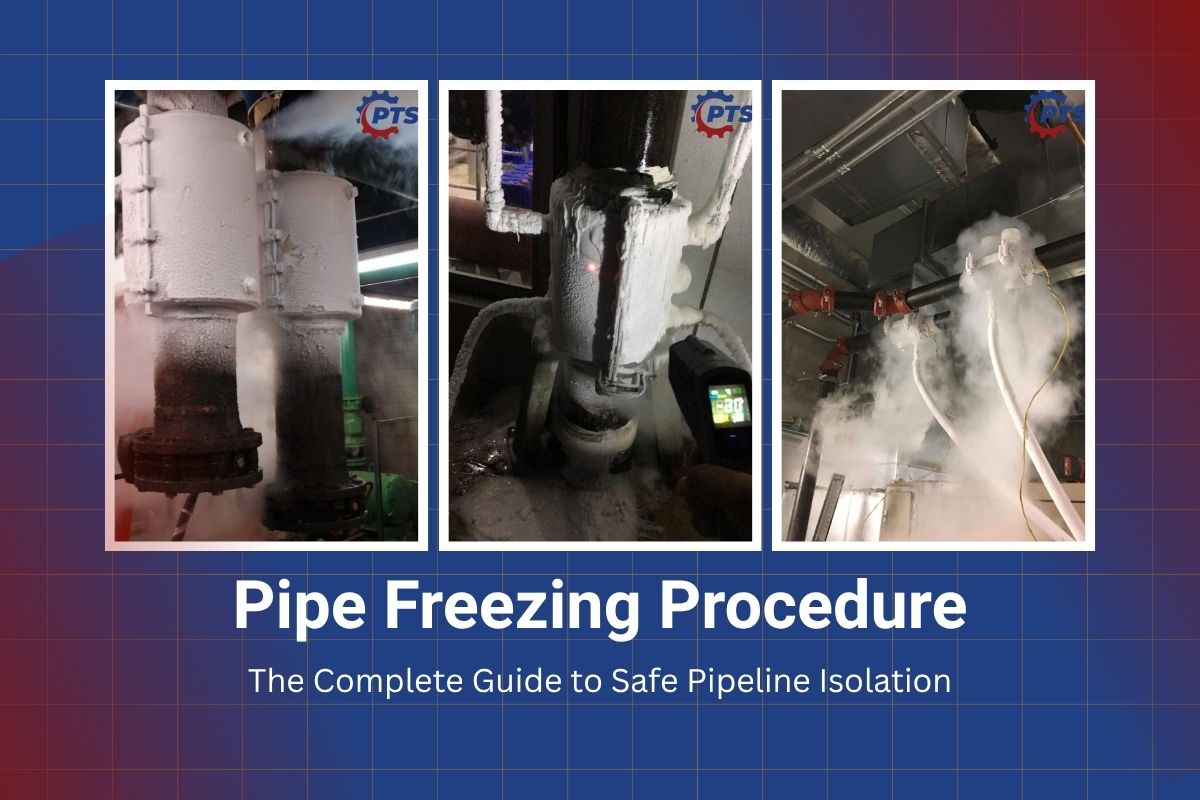
A pipe freezing procedure — also referred to as cryogenic pipe freezing or pipe freeze isolation — is a controlled technique that uses extreme cold to freeze the liquid content inside a pipe segment, forming an ice plug that acts as a temporary isolation barrier. This allows engineers to safely perform maintenance, valve replacement, or system modifications on the downstream or upstream side of the plug, while the rest of the pipeline remains live and pressurised.
Unlike conventional flow-stopping methods that require installed line stop fittings or the removal of existing valves, pipe freezing works non-invasively around the exterior of the pipe. The freeze jackets or clamps are applied to the outside of the pipe, and the freezant circulates around the pipe wall to bring the internal fluid to its freezing point.
The result is an ice plug that is structurally robust enough to hold pipeline pressure — typically up to 1,500 psi depending on pipe diameter and configuration — while remaining completely safe to thaw and release once work is complete.
Pipe freezing is the only pipeline isolation technique that requires no physical entry into the pipe, no system drain-down, and leaves absolutely no permanent hardware behind.
The Science Behind Cryogenic Pipe Freezing
The pipe freeze technique relies on a straightforward thermodynamic principle: reducing the temperature of the fluid inside the pipe below its freezing point causes it to solidify into a rigid plug. The challenge lies in doing this reliably, safely, and in a controlled manner — particularly in industrial pipelines carrying fluids under pressure.
Two primary freezant media are used in cryogenic pipe freezing:
Liquid Nitrogen (LN₂)
Liquid nitrogen operates at approximately -196°C (-321°F) and is the most powerful freezant available for pipe isolation. It is used for large-diameter pipes, pipes carrying fluids with low freezing points (such as brine, glycol solutions, or chemical streams), and situations where a rapid freeze is required. LN₂ is delivered to the freeze jacket and allowed to circulate, extracting heat from the pipe wall and the internal fluid until a solid plug forms.
Carbon Dioxide (CO₂)
Carbon dioxide is used for smaller pipe diameters and water-based applications, delivering temperatures around -78°C (-109°F). It is cost-effective, easy to handle, and ideal for routine maintenance tasks in water distribution networks. CO₂ freeze kits are commonly deployed for domestic and light industrial pipe work.
PTS engineers select the appropriate freezant based on pipe diameter, operating pressure, fluid composition, and ambient conditions — ensuring the right pipe freeze technique for every application.
Step-by-Step Pipe Freezing Procedure
Understanding the full pipe freezing procedure helps project engineers, HSE managers, and procurement teams make informed decisions. Below is a condensed version of the standard methodology deployed by PTS field teams.
Step 1: Pre-Job Engineering Assessment
Before any equipment is mobilised, PTS conducts a thorough pre-job assessment. This includes pipe diameter and material review (steel, ductile iron, HDPE, copper, stainless), fluid type and its freezing characteristics, operating pressure and temperature conditions, ambient temperature at the work site, available access space for freeze clamps and LN₂ dewars, and any special considerations such as the presence of inhibitors or antifreeze additives in the fluid.
This stage determines which freezant medium is appropriate, the size and number of freeze jackets required, and the estimated freeze time. It also identifies any risks — for example, pipelines carrying fluids with significantly depressed freezing points may require LN₂ rather than CO₂.
Step 2: Site Preparation and Safety Measures
Cryogenic pipe freezing involves the handling of extremely cold substances and pressurised pipelines. Strict safety protocols are observed at every PTS job site. This includes exclusion zones around the freeze point to prevent cryogenic burns, PPE requirements for all personnel including cryogenic gloves and face shields, gas detection for nitrogen-enriched atmospheres (critical in enclosed spaces), pressure monitoring on the isolated section to prevent over-pressure build-up, and a documented risk assessment and method statement (RAMS) signed off before work commences.
For chemical industry applications, additional COSHH considerations apply depending on the fluid being carried in the pipeline.
Step 3: Application of Freeze Jackets
Once the site is prepared, PTS engineers apply the freeze jackets — specially designed insulated clamps that wrap around the pipe exterior at the designated freeze point. The jackets are engineered to maintain intimate contact with the pipe outer surface and distribute the freezant evenly around the circumference. Multiple jackets may be applied to ensure a complete and reliable plug, particularly on larger diameter pipes.
Step 4: Introduction of Freezant and Ice Plug Formation
The cryogenic medium — LN₂ or CO₂ — is introduced into the freeze jackets. Temperature sensors and thermal monitoring equipment track the progress of the freeze in real time. As the pipe wall temperature drops, the internal fluid begins to solidify outward from the pipe wall toward the centre, ultimately forming a complete ice plug across the bore.
Freeze time varies depending on pipe diameter, fluid type, and freezant medium. Small bore water pipes (up to 25mm) may freeze in minutes, while large industrial pipes (300mm and above) can take several hours. PTS engineers monitor the process continuously throughout.
Step 5: Pressure Testing the Ice Plug
Before any downstream work begins, the integrity of the ice plug must be confirmed. PTS engineers perform a pressure test against the plug to verify it can hold the line pressure without migration or failure. This is a non-negotiable step in the pipe freezing procedure and is recorded as part of the job documentation.
Step 6: Maintenance Work Execution
With the ice plug confirmed and holding, the downstream or upstream section is now safely isolated. Engineers can proceed with the required maintenance — valve replacement, spool piece installation, modification of fittings, insertion of new branch connections, or inspection work. Because the rest of the system remains operational, there is no disruption to service continuity.
Step 7: Controlled Thaw and Reinstatement
Once maintenance is complete, the freeze jackets are removed and the ice plug is allowed to thaw naturally, or thawing is assisted using warm water or purpose-designed heating equipment. The pipeline is reinspected to confirm full flow is restored, the system is returned to service, and all temporary equipment is de-mobilised. No residual hardware remains in the pipeline.
PTS deploys real-time thermal monitoring throughout the freeze process, providing our clients with documented evidence of plug formation and integrity — critical for regulated industries such as water supply and chemical processing.
Pipe Freeze Technique: Industry Applications
The versatility of the cryogenic pipe freezing technique means it is deployed across a wide range of sectors. PTS has accumulated extensive field experience in the following key industries:
Water Distribution and Utilities
Municipal water networks present constant maintenance challenges. Main replacements, hydrant upgrades, meter installations, and service interruptions all require isolation of live pressurised mains. The pipe freeze technique allows water utilities to carry out this work without the cost and disruption of complete network shut-downs, protecting supply continuity for thousands of connected properties.
Chemical Processing Plants
In chemical plants, pipelines frequently carry aggressive, hazardous, or high-value process fluids. Draining and flushing these lines for maintenance introduces serious contamination, disposal, and safety risks. Cryogenic pipe freezing enables chemical engineers to isolate individual process lines while the surrounding plant remains operational, dramatically reducing maintenance downtime and the associated costs of production loss.
Oil & Gas and Petrochemical
Pipeline isolation in hydrocarbon environments demands the highest standards of engineering and safety assurance. PTS has carried out pipe freezing procedures on fuel gas lines, cooling water circuits, and process pipework in downstream petrochemical facilities, delivering reliable isolations in some of the industry’s most demanding environments.
Power Generation
Cooling water systems, fire suppression networks, and auxiliary piping in power stations are all prime candidates for pipe freeze isolation. Planned and unplanned maintenance can be executed without taking plant sections offline, protecting both asset availability and generation revenue.
Pipe Freezing vs. Conventional Isolation: A Comparison
The table below compares the pipe freeze technique against traditional pipeline isolation approaches across key operational parameters.
| Parameter | Pipe Freezing (Cryogenic) | Drain-Down & Refill | Line Stop Fitting |
|---|---|---|---|
| System Shutdown Required | No | Yes | Partial |
| Permanent Hardware Left in Line | None | None | Yes (fitting remains) |
| Suitable for Chemical Lines | Yes (with LN₂) | High risk | Limited |
| Typical Mobilisation Time | Hours | Days | Days |
| Post-Work System Reinstatement | Thaw & restore | Full flush & refill | Permanent |
| Environmental Risk | Very Low | High (chemical disposal) | Low |
| Cost Efficiency for Short Works | High | Low | Moderate |
Key Considerations for a Safe Pipe Freezing Procedure
While cryogenic pipe freezing is a proven and safe technique when properly executed, there are several critical factors that determine the success and safety of each operation:
- Fluid composition matters enormously. Pure water freezes reliably at 0°C, but process fluids containing glycols, salts, or chemical inhibitors have depressed freezing points. PTS engineers verify fluid specifications before selecting the appropriate freezant and confirming feasibility.
- Pipe material compatibility must be assessed. Carbon steel, stainless steel, ductile iron, and copper all respond well to cryogenic pipe freezing. HDPE and some plastics require careful engineering assessment due to their differential thermal expansion characteristics.
- System pressure must be managed. An isolated section of pipe can experience pressure build-up due to thermal expansion of the trapped fluid. Pressure relief provisions must be included in the procedure design.
- Multiple freeze points may be required. For long spools or complex configurations, engineers may need to create two ice plugs to ensure a safe working zone between them.
- Never freeze a gas line. Pipe freezing is only appropriate for liquid-filled pipes. Attempting to freeze a gas-carrying line is extremely dangerous and will not produce a reliable isolation.
Why Choose PTS for Your Pipe Freezing Requirements?
PTS (Pipeline Technical Services) is a specialist pipeline maintenance services company with global operational experience across the water, chemical, oil & gas, and power generation sectors. Our pipe freezing service is backed by:
- Fully trained and certified cryogenic technicians with extensive field experience
- A comprehensive equipment inventory covering pipe diameters from 15mm to 600mm and beyond
- Rigorous HSE management including documented RAMS, toolbox talks, and live monitoring
- Integrated service capability — pipe freezing can be combined with hot tapping, line stopping, and cold cutting for complex isolation scenarios
- Rapid mobilisation for both planned and emergency maintenance requirements
- Full post-job documentation including thermal records, pressure test results, and reinstatement confirmation
PTS has successfully delivered cryogenic pipe freezing projects across water utilities, chemical processing facilities, and industrial plants, building a track record of zero-incident operations in some of the most demanding pipeline environments in the world.
“Whether you are replacing a corroded valve in a live water main or isolating a chemical process line for urgent maintenance, PTS has the expertise, equipment, and commitment to deliver a safe and reliable pipe freezing solution.” — PTS Engineering Team
Conclusion
The pipe freezing procedure has firmly established itself as the smart, safe, and sustainable alternative to system drain-downs and unplanned shutdowns in the water and chemical industries. By harnessing the physics of cryogenic pipe freezing, engineers can isolate any section of a live pressurised pipeline — quickly, safely, and without leaving a trace.
For water utilities looking to protect service continuity, chemical plant operators seeking to avoid costly production interruptions, and industrial engineers requiring flexible, non-invasive pipeline isolation, the pipe freeze technique offers a compelling answer.
PTS brings the full depth of technical expertise, certified personnel, and specialized equipment needed to execute pipe freezing procedures to the highest standards of safety and quality. Contact our team today to discuss your next project.