
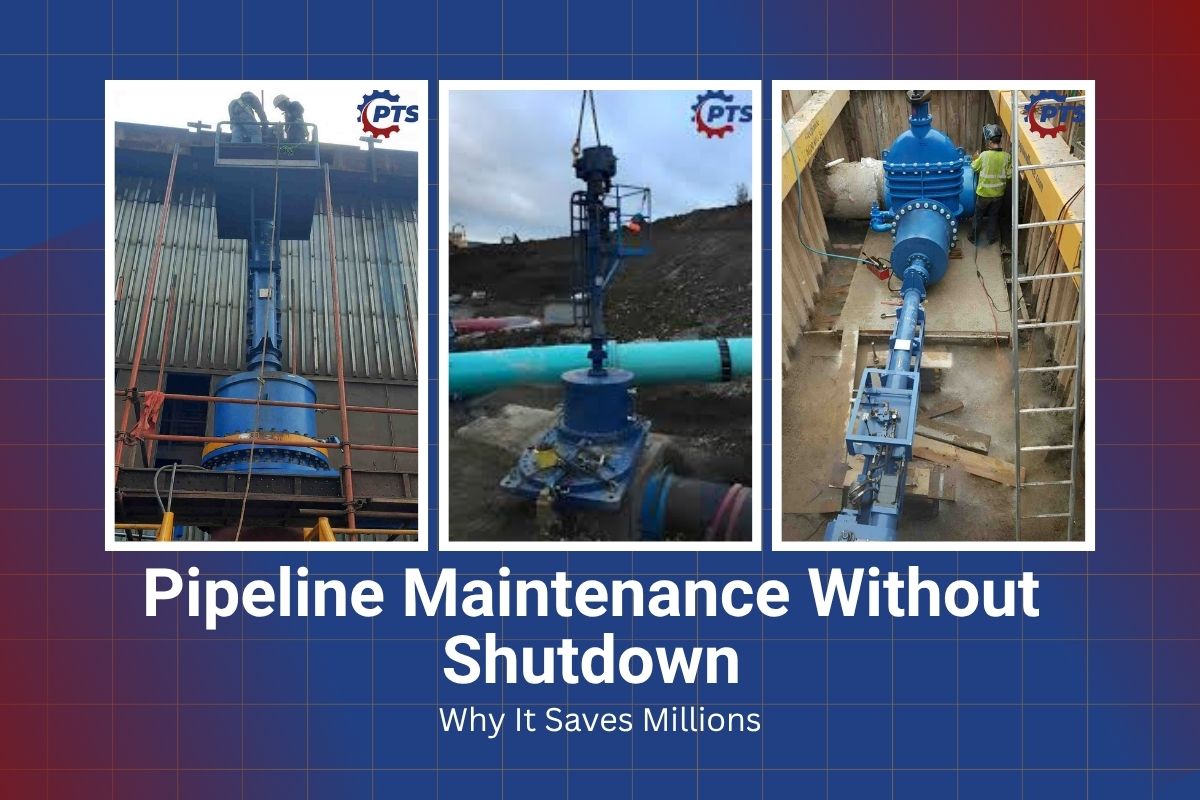
Every pipeline that carries water, oil, gas, steam, or chemicals is a productive asset. The moment it goes offline, the losses begin—lost production, idle labor, missed supply commitments, regulatory scrutiny, and in some cases, emergency response costs that dwarf the original maintenance budget. This is why pipeline maintenance without shutdown has become increasingly important across industries. Yet for much of the 20th century, shutting down was simply how pipeline maintenance was done. If something needed fixing, the system went offline, the fluid was drained, and work began.
That thinking has fundamentally changed. Today, pipeline maintenance without shutdown is not just technically possible — it is the preferred methodology for operators across the oil and gas, water, chemical, and power generation sectors worldwide. Purpose-engineered techniques allow engineers to repair, modify, and upgrade live, pressurised pipelines while fluid continues to flow. The result is a transformation in how asset owners calculate the true cost of maintenance.
At PTS, live pipeline repair and no shutdown maintenance is our core business. This blog explains why this approach saves millions, how it works, which techniques are available, and what global industries are gaining by making the switch.
The True Cost of a Pipeline Shutdown
When pipeline operators consider the cost of maintenance, they typically think about labour, materials, and contractor fees. What is frequently underestimated — or entirely missed — is the cost of the shutdown itself. In reality, for many facilities and networks, the shutdown cost dwarfs the maintenance cost by a significant multiple.
Consider what a pipeline shutdown actually involves in a major industrial or utility context. Production stops on all connected processes. Fluid drain-down and flushing operations begin, which for chemical lines may involve hazardous waste disposal. System reinstatement — refilling, purging, pressure testing, and recommissioning — can take as long as or longer than the maintenance work itself. In water distribution, customers lose supply. In oil and gas, production revenues stop. In chemical plants, batch processes are disrupted. In power generation, capacity is curtailed.
According to industry estimates, unplanned pipeline downtime in the oil and gas sector alone costs operators an average of USD 500,000 per day in lost production and associated costs. For large-diameter transmission infrastructure or critical process lines, that figure is often higher. Even planned shutdowns in water utilities carry significant costs — emergency supply arrangements, customer compensation, regulatory compliance reporting, and the reputational damage of service interruptions all add up rapidly.
Live pipeline repair eliminates not just maintenance downtime — it eliminates the entire cost category of shutdown, drain-down, and system reinstatement. That is where the millions are saved.
What Is Pipeline Maintenance Without Shutdown?
Pipeline maintenance without shutdown refers to a family of engineering techniques that allow maintenance, modification, repair, or upgrade work to be carried out on a live, pressurised pipeline — without stopping flow, without draining the system, and without taking the broader network offline. These techniques are collectively sometimes referred to as no shutdown maintenance or live pipeline repair, and they represent the modern standard for pipeline asset management in industries where service continuity is critical.
The techniques that fall under this category include hot tapping (drilling into a live pressurised pipe to add a branch connection), line stopping (mechanically plugging a section of a live pipe to create a temporary isolation zone), pipe freezing (creating an ice plug inside the pipe using cryogenic technology), and cold cutting (mechanically cutting pipe sections without heat or spark). Each technique has specific applications and selection criteria, but all share the same fundamental benefit: the system keeps running while the work gets done.
PTS specialises in all of these no shutdown maintenance techniques and has deployed them across pipeline systems ranging from 15mm domestic water mains to 1,000mm industrial transmission lines in over a dozen countries.
Core Techniques for Live Pipeline Repair
Hot Tapping
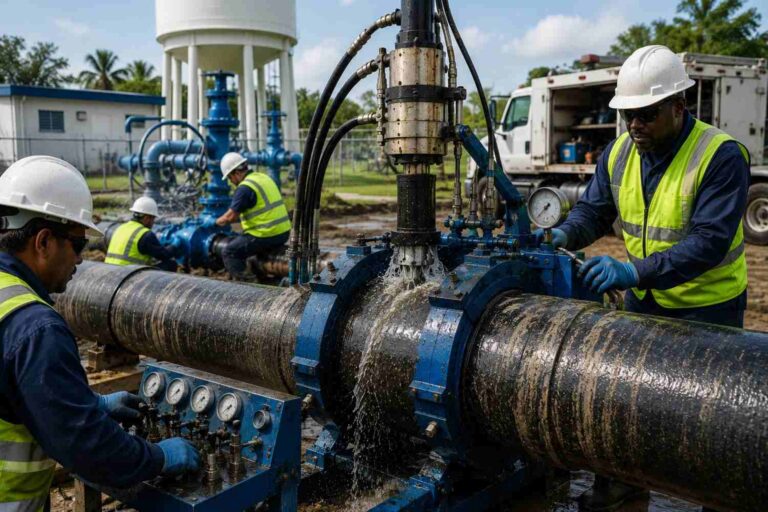
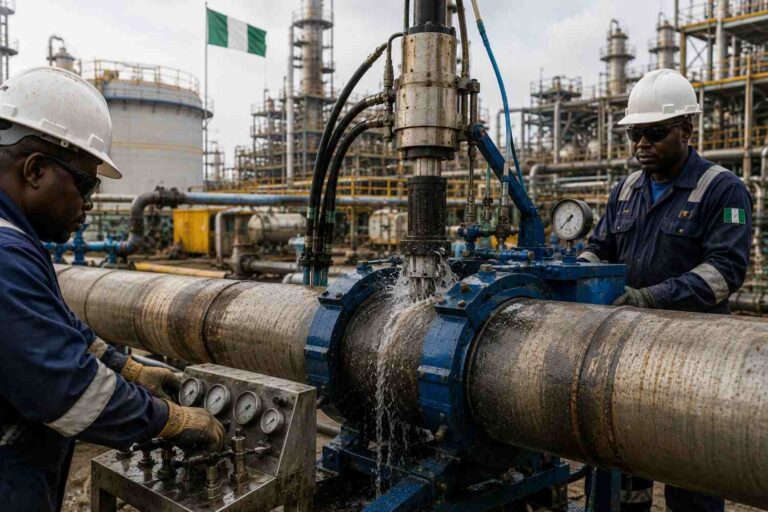
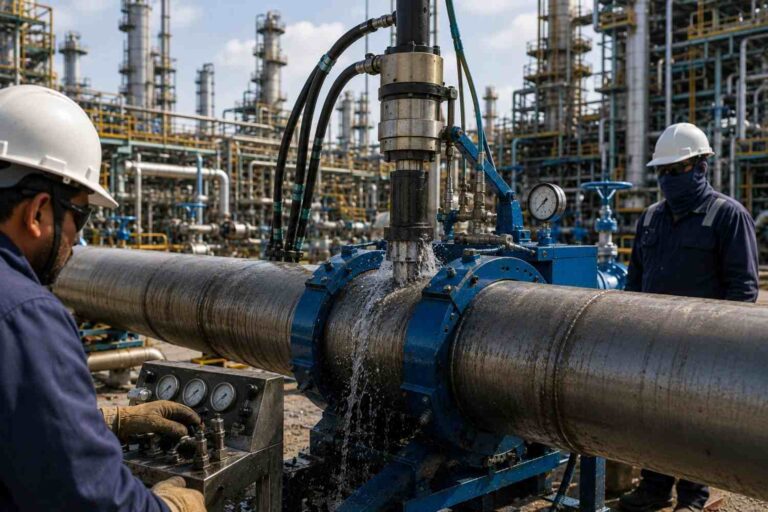
Hot tapping is the process of drilling into a live, pressurised pipeline to create a new branch connection without stopping flow. A specially designed fitting is welded or bolted to the pipe exterior, a valve is attached, and a hot tap machine drills through the pipe wall under full pressure. The result is a new branch connection — for isolation fittings, bypass lines, monitoring points, or new service connections — with zero interruption to flow. Hot tapping is one of the most widely used live pipeline repair techniques globally and is applicable to steel, ductile iron, HDPE, and stainless steel pipelines across virtually every fluid type.
Line Stopping
Line stopping uses the access point created by a hot tap to insert a mechanical plugging head into the live pipe bore, creating a temporary isolation zone. Downstream work — valve replacements, spool piece installations, tie-ins — can then be carried out safely while the isolated section is at atmospheric pressure. A bypass line maintains flow around the isolated zone, ensuring no service interruption to downstream users. Once work is complete, the plug is withdrawn, the bypass is removed, and the system is restored to normal operation. Line stopping is the most powerful no shutdown maintenance tool available for complex pipeline interventions.
Pipe Freezing
Pipe freezing — also known as cryogenic pipe freezing — uses liquid nitrogen or carbon dioxide to freeze the internal fluid of a pipe segment into a solid ice plug, creating a temporary isolation barrier without any mechanical intrusion into the pipe bore. This is particularly valuable in situations where no installed valves are available, where access for hot tap fittings is restricted, or where the pipeline system is too small for conventional line stop equipment. Pipe freezing leaves no permanent hardware in the pipeline and is widely used in water distribution, chemical processing, and HVAC applications.
Cold Cutting
Cold cutting is a mechanical pipe cutting technique that removes sections of pipe without generating heat, sparks, or open flames. This makes it the only safe cutting method for pipelines in classified hazardous areas, pipelines that have carried flammable or explosive fluids, and situations where hot work permits are unavailable or undesirable. Cold cutting is routinely used in conjunction with line stopping and hot tapping to complete complex no shutdown maintenance operations in a single mobilisation.
Shutdown vs. No Shutdown Maintenance: The Financial Case
The table below illustrates the cost comparison between a conventional shutdown approach and a no shutdown maintenance strategy for a representative industrial pipeline maintenance scenario.
| Cost Category | Conventional Shutdown | No Shutdown Maintenance (PTS) |
|---|---|---|
| Production / Supply Loss | High — full stoppage | None — system remains live |
| Drain-down & Flushing | Required — hours to days | Not required |
| System Reinstatement | Required — pressure test, purge, recommission | Not required |
| Hazardous Waste Disposal | Often required for chemical lines | Eliminated |
| Customer / Offtaker Impact | Significant | Minimal to none |
| Emergency Supply Arrangements | Often required (water utilities) | Not required |
| Total Maintenance Duration | Days to weeks | Hours to days |
| Risk of Collateral Damage | Higher (thermal stress, contamination) | Significantly lower |
Industry Applications: Where No Shutdown Maintenance Delivers the Greatest Value
Oil & Gas
Upstream and midstream oil and gas operators face some of the most demanding pipeline maintenance environments on earth. High pressures, hazardous fluids, remote locations, and the constant pressure of production targets make live pipeline repair not just commercially attractive — it is often operationally essential. PTS has carried out hot tapping and line stop operations on high-pressure gas transmission lines, produced water systems, and fuel distribution networks, delivering reliable no shutdown maintenance outcomes in environments where a conventional shutdown would have meant weeks of lost production.
Water Utilities & Municipal Infrastructure
For water utilities, the ability to carry out pipeline maintenance without shutdown is directly tied to their duty of care to customers. Planned shutdowns in water distribution networks trigger a cascade of obligations — alternative supply arrangements, customer notifications, regulatory reporting, and the logistical challenge of managing a depressurised network in a live urban environment. PTS pipe freezing and line stop services allow water utilities to replace ageing valves, install new service connections, and repair deteriorating mains without any of this disruption. The operational savings are significant; the reputational savings are immeasurable.
Chemical Processing
Chemical plants present some of the most compelling arguments for no shutdown maintenance. Process lines carrying acids, solvents, reactants, or high-temperature fluids cannot simply be drained and left open — every intervention carries contamination, disposal, and safety risks. Pipeline maintenance without shutdown eliminates the need to drain, flush, and decontaminate process lines for routine interventions. This reduces hazardous waste generation, cuts maintenance cycle times, and significantly lowers the risk exposure of both maintenance personnel and the surrounding environment.
Power Generation
Power stations — whether coal, gas, nuclear, or renewable — contain extensive auxiliary pipeline systems: cooling water circuits, steam lines, condensate systems, fire suppression networks, and fuel supply lines. Shutting down any of these systems for maintenance often requires reducing or halting generation output. Live pipeline repair techniques allow power plant engineers to address maintenance requirements on auxiliary systems while the plant continues to generate, protecting both revenue and grid commitments.
Safety: The Non-Negotiable Foundation of Live Pipeline Repair
A question that every responsible asset owner asks is this: is working on a live, pressurised pipeline safe? The answer — when the work is carried out by properly trained specialists with purpose-designed equipment and rigorous safety management — is unequivocally yes. In fact, for many pipeline interventions, live pipeline repair is demonstrably safer than a conventional shutdown approach, for several reasons.
First, pipeline maintenance without shutdown avoids the thermal stresses, pressure cycles, and contamination risks associated with drain-down and reinstatement. Second, it eliminates the need for hot work in many scenarios — replacing cutting and welding with mechanical techniques that carry lower ignition risk. Third, it reduces the duration of personnel exposure to hazardous pipeline environments, since work is completed faster and more efficiently.
PTS operates to the highest international safety standards on every live pipeline repair project. This includes full engineering risk assessments and method statements before mobilisation, compliance with OSHA, ASME B31.3, API standards, and applicable local regulations, continuous pressure and flow monitoring throughout operations, trained cryogenic and hot tap technicians with current competency certification, and emergency shutdown and isolation provisions built into every job plan.
At PTS, safety is not a checklist — it is the engineering discipline that makes pipeline maintenance without shutdown possible in the first place.
Why Global Operators Choose PTS for No Shutdown Maintenance
PTS (Plant Technology Services Group) is a globally active specialist contractor delivering pipeline maintenance without shutdown across the oil and gas, water, chemical, and power generation sectors. Our capability spans the full range of live pipeline repair techniques — hot tapping, line stopping, pipe freezing, and cold cutting — and we have the equipment inventory, technical expertise, and field experience to handle pipeline diameters from 15mm to 1,000mm across steel, ductile iron, HDPE, copper, and stainless steel.
What distinguishes PTS is the integration of these techniques into comprehensive no shutdown maintenance programmes tailored to each client’s operational context. Where other contractors might offer a single technique, PTS brings the full toolkit — meaning complex maintenance scenarios that require a combination of hot tap access, line stop isolation, and cold cut removal can be executed in a single, coordinated mobilisation rather than multiple separate interventions.
- Global project experience across four continents
- Full engineering design and risk assessment capability in-house
- Rapid mobilisation for both planned maintenance and emergency response
- Comprehensive equipment inventory for all pipe sizes and materials
- Integrated HSE management system certified to international standards
- Post-job documentation including pressure records, test certificates, and photographic evidence
Conclusion
The case for pipeline maintenance without shutdown has never been stronger. As pipeline infrastructure ages, as operational demands intensify, and as the financial and reputational consequences of service interruptions grow, the traditional approach of shutting down, draining, and reinstatement is increasingly untenable. Live pipeline repair techniques — hot tapping, line stopping, pipe freezing, and cold cutting — have matured into reliable, safe, and cost-effective alternatives that global operators in every major sector are now deploying as standard practice.
The financial argument is compelling: eliminating shutdown costs, production losses, drain-down operations, and reinstatement cycles can save individual operators millions of dollars per maintenance cycle. The safety argument is equally strong: properly executed no shutdown maintenance reduces risk exposure, eliminates thermal cycling damage, and cuts personnel time in hazardous environments. And the operational argument is perhaps the most powerful of all — infrastructure that stays live serves customers, generates revenue, and fulfils obligations without interruption.
PTS is ready to help your organization make the transition to pipeline maintenance without shutdown. Whether you are planning a scheduled maintenance program or facing an urgent live pipeline repair requirement, our specialist team has the expertise, equipment, and global reach to deliver. Contact us at info@pts.group to discuss your requirements with our engineering team.